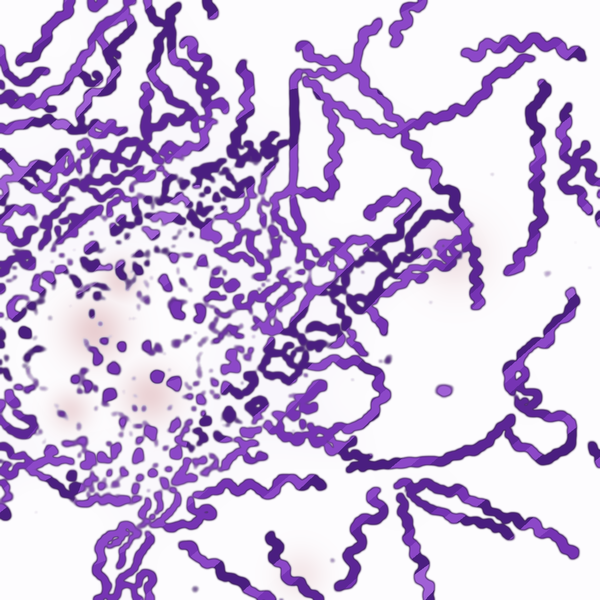
Borrelia burgdorferi and Lyme disease, including evaluating anecdotal Lyme disease treatments in search of borreliacidal compounds.
My Biochemistry honors thesis at Wellesley College, conducted with the Antimicrobial Discovery Center at Northeastern University, made three contributions to the study of Borrelia: (1) identifying several Borrelia-inhibitory compounds, including a growth accelerator and a Borrelia killer several times more effective than the control antibiotic; (2) drawing novel synthetic connections from existing data relevant to the ecological mitigation and clinical treatment of Lyme disease; and (3) designing and piloting a novel semi-lawn plating approach to address a primary lack of lawn-type testing in Borrelia research. Related earlier work at the Center includes an internship on Borrelia-inhibitory compounds (2018) and an REU in the Lewis Lab testing microbial metabolites for antimicrobial action (summer 2017).
Kerns, S. (2019). Evaluating anecdotal Lyme disease treatments for Borrelia-inhibitory properties. [Honors thesis, Wellesley College]. Wellesley College Digital Repository. Research conducted with the Antimicrobial Discovery Center, Northeastern University. https://repository.wellesley.edu/object/ir858
Presentations
Invited panel presentation
Kerns, S. H. (2019). Evaluating anecdotal Lyme disease treatments in search of borreliacidal compounds. Panel presentation, Biochemistry Panel, Ruhlman Conference, Wellesley College. Slides available on request.
Invited talk
Kerns, S. H. (2017). Science writ small: Antibiotic research, immersive education, and saving the world. Talk, Tanner Conference, Wellesley College. Slides available on request.
Books and pop-science writing
Kerns, S.Building a Better Spirochete Trap: Using Engineered Proteins to Create Effective Immunization Against the Unusual Pathogen Borrelia burgdorferi. PDF
Kerns, S.It’s a Jungle in There: The Wild and Wonderful World of Microbiomes [Children’s Book]. PDF (draft)